
Investor Note · 12 May 2026 · Part 2 of 2
The Ijarah Edge. Why Structure Matters.
Not all sukuk are equal. The structure — Ijarah, Murabaha, Wakala, Musharaka — determines what you keep after zakat.
Invesense Research · Fiqh Council · AAOIFI · Razak, Saiti & Dinç (2019) · Sa’ada (Journal of Islamic Finance) · Asian Economic & Financial Review (2022)
$2.15M
Ijarah vs deposit gap
$1M @ 5%, 30 years
96.5%
Pre-zakat return retained
by Ijarah holders
46.8%
Retained by deposits
& Murabaha
75%
Ijarah + Wakalah share
of global sukuk issuance
In Part 1, we established that the global sukuk market has crossed $1 trillion. But not all sukuk are equal. The structure — Ijarah, Murabaha, Wakala, Musharaka — determines far more than its cash-flow profile. It determines what you keep after zakat. For Muslim investors allocating to fixed income, this distinction is worth millions over a lifetime.
01
The Zakat Math.
$2,148,053. That is the difference between choosing Ijarah sukuk and a bank deposit on the same $1 million, at the same 5% yield, over 30 years. Ijarah holders pay zakat at 2.5% on rental profits only — $1,250 per year on $1 million earning 5%. Deposit holders pay 2.5% on the full principal plus accumulated profits — $26,250 per year. The Fiqh Council confirms: for Ijarah sukuk held as long-term investments, zakat applies to the usufruct, not the underlying asset.
Ijarah retains 96.5% of the pre-zakat return. Deposits retain only (46.8%). At 10 years, the gap is $345,000. At 20 years, $992,000. At 30 years, it exceeds the original principal. This is not a rounding error — it is a return driver.
02
Why Structure Matters.
Ijarah is a lease. The investor owns the underlying asset — real estate, equipment, infrastructure — and the issuer pays rental income. The principal is backed by a tangible asset, not a cost-plus receivable or an agency arrangement. Razak, Saiti & Dinç (2019, Borsa Istanbul Review) documented that Ijarah and Wakalah combined account for 75% of global sukuk issuance. Ijarah became the dominant structure after AAOIFI’s 2008 ruling tightened requirements on equity-based structures.
Zakat Treatment by Sukuk Structure
30-year terminal value on $1,000,000 at 5% yield · share of pre-zakat return retained
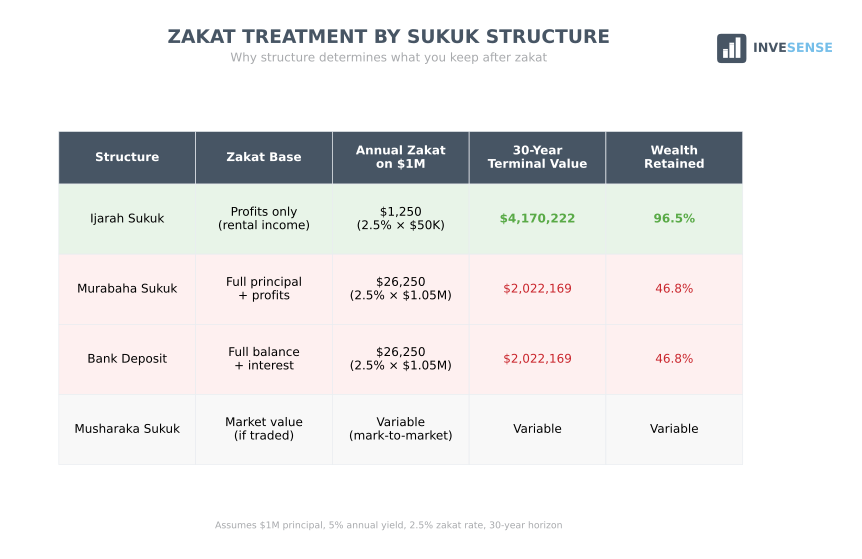
Invesense Research · 2.5% annual zakat rate, long-term holding intention per Fiqh Council guidance.
| Structure | Zakat base | Annual zakat on $1M | 30-year terminal | Retained |
|---|---|---|---|---|
| Ijarah | Profits only | $1,250 | $4,170,222 | 96.5% |
| Murabaha | Full principal + profits | $26,250 | $2,022,169 | 46.8% |
| Deposit | Full balance + interest | $26,250 | $2,022,169 | 46.8% |
| Musharaka | Market value (if traded) | Variable | Variable | Variable |
The pre-zakat yield on Ijarah may look tighter — Sa’ada (Journal of Islamic Finance) found Ijarah pricing at 86 bps below conventional equivalents. But the after-zakat picture reverses entirely. The investor who optimises for pre-zakat yield and ignores structure is leaving wealth on the table.
03
Why Our Portfolio Is Exclusively Ijarah.
Our sukuk allocation is 100% Ijarah. Not by default — by design. Three structural advantages: zakat efficiency for clients, real asset backing for security, and predictable rental cash flows for income stability. The gap widens with yield: at 3%, the 30-year Ijarah advantage is $1.24 million. At 5%, $2.15 million. At 7%, $3.69 million.
This is why Ijarah sukuk trade at a premium — rational demand from the world’s largest zakat-conscious wealth pools across Kuwait, Saudi Arabia, and the UAE. The premium is structural and persistent. A zakat-integrated portfolio construction framework (2022, Asian Economic and Financial Review) confirms that treating zakat as an explicit cost improves risk-adjusted returns for institutional portfolios.
Our View
Structure is not a technicality — it determines what you keep after zakat. For Muslim investors holding fixed income over decades, the difference between 2.5% on profits and 2.5% on principal is millions in preserved wealth. Our sukuk portfolio is exclusively Ijarah because it is the only structure that fully aligns the investment obligation with the zakat obligation.
This closes our two-part series on the sukuk market — from the $1 trillion milestone to the structure that makes it work for you.
Speak with our investment team
We are available to discuss how this applies to your specific allocation.
Invesense Asset Management Ltd. is regulated by the Dubai Financial Services Authority (DFSA). This material is for informational purposes only and does not constitute investment advice or an offer to buy or sell any securities. Past performance is not indicative of future results. Zakat calculations assume a 2.5% annual rate on the applicable base, 5% yield, and a long-term holding intention per Fiqh Council guidance; individual zakat obligations may vary based on structure and local scholarly interpretation. Computations by Invesense Research.
← Back to Insights