
Investor Note · 30 April 2026
Sell in May and Pray You Come Back.
98 years of data say the pattern is real. The trade isn’t. November–April compounds at +14.5% annualized versus 9.3% for May–October — but the investor who acts on it ends up 6.3 times poorer than the one who ignores it.
Invesense Research · S&P Dow Jones Indices · January 1928 – February 2026
+14.5%
Nov–Apr CAGR
98-year average
9.3%
May–Oct CAGR
98-year average
$96M
Gap vs buy-and-hold
on a $10,000 stake
(0.83%)
September avg return
the only negative month
Every April, the same advice resurfaces: sell in May and go away. We tested it. 98 years of S&P 500 total return data, January 1928 to February 2026. The seasonal gap exists — November through April has compounded at +14.5% annualized versus 9.3% for May through October. But the investor who acts on it ends up 6.3 times poorer than the one who ignores it. The pattern describes the market. It does not prescribe a strategy.
01
The Gap Is Real. And It Persists.
Over 98 years, $10,000 invested only during November through April grew to $3.9 million. The same $10,000 invested only during May through October reached just $290,000 — a 13.5× gap. Bouman & Jacobsen (American Economic Review, 2002) documented the anomaly across 37 countries, finding statistical significance in 36 of them. Zhang & Jacobsen (Journal of International Money and Finance, 2021) confirmed it again with 62,962 observations: the winter premium averaged roughly 4 percentage points annually, persisting across every region and every sub-period tested. Nov–Apr won 8 of 11 decades since the 1920s — failing only in the 1930s, 1940s, and the current decade.
02
The Trade Destroys the Edge.
$10,000 invested in January 1928 and left alone grew to $114.1 million at a +10.0% CAGR. The same $10,000 under a strict sell-in-May strategy — equities November through April, Treasury bills May through October — reached just $18.0 million at 7.9% CAGR. That is a $96 million gap created by six months of annual absence. And this calculation is generous: it excludes transaction costs, bid-ask spreads, and the short-term capital gains tax triggered every November re-entry. The real-world gap would be wider. Malkiel, Saha & Grecu (Princeton CEPS, 2009) examined a broad set of timing strategies and concluded that none beat buy-and-hold after costs. The edge evaporates the moment you try to capture it.
$10,000 Invested in 1928: Four Strategies Compared
Terminal value, January 1928 – February 2026
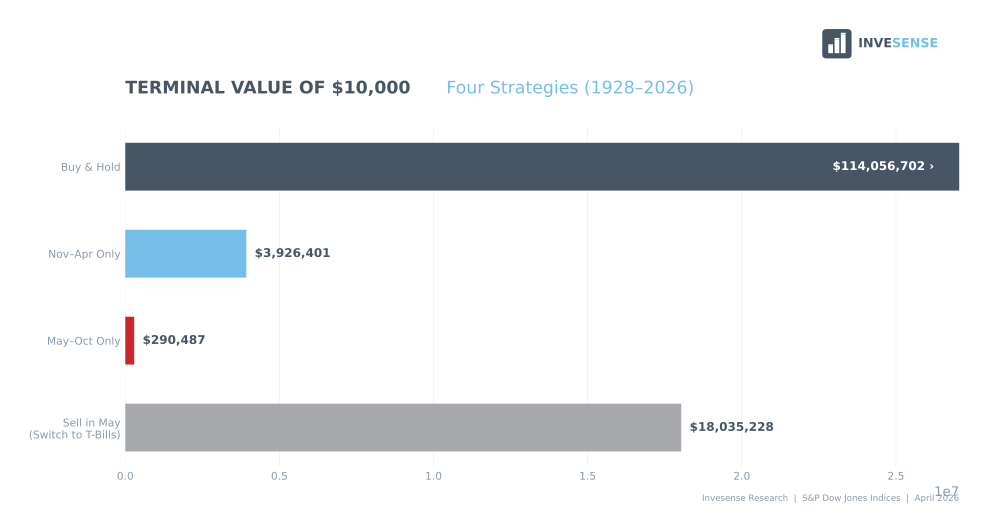
S&P Dow Jones Indices · Invesense Research.
03
It’s Volatility Clustering, Not Calendar Magic.
September is the only month with a negative average return over 98 years: (0.83%). October carries the crashes — 1929, 1987, 2008. But October also delivers some of the sharpest recoveries: +16.7% in October 1974, +11.5% in October 1982. The sell-in-May investor misses both the damage and the repair. Meanwhile, July — squarely inside the “bad” half — is the single best month of the year at +1.95% average. The seasonal pattern is driven by volatility clustering around the September–October window, not by a reliable six-month drought. We showed in our March 2026 note that 6 of the 10 best trading days fell within 15 calendar days of the worst. The mechanism is the same: the months you fear most contain the recoveries you cannot afford to miss.
Our View
The November–April edge is real in the data — roughly +14.5% annualized versus 9.3% for May–October over 98 years. But the investor who trades it pays entry and exit costs, triggers short-term capital gains every November, and risks missing October recoveries that have historically erased the prior month’s damage.
Seasonality is a description, not a strategy. The edge belongs to the investor who stays invested through both halves of the calendar.
Speak with our investment team
For a deeper discussion on how these themes apply to your portfolio, we welcome a conversation.
Invesense Asset Management Ltd. is regulated by the Dubai Financial Services Authority (DFSA). This material is for informational purposes only and does not constitute investment advice or an offer to buy or sell any securities. Past performance is not indicative of future results. Data: S&P 500 total return index, January 1928 – February 2026 (S&P Dow Jones Indices). Treasury bill series for the sell-in-May simulation. Computations by Invesense Research.
← Back to Insights